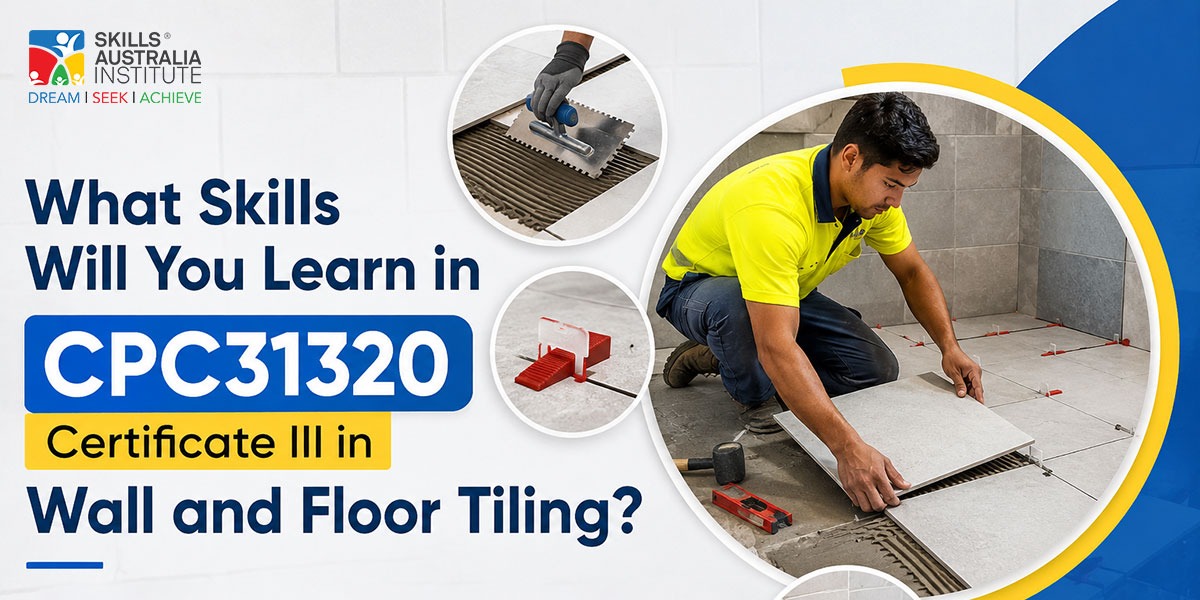
Tiling is one of those trades people never really stop needing. Bathrooms get renovated, kitchens get redone, new homes keep going up, and every one of them needs someone who knows how to lay tiles properly. If you’re considering a hands-on career with real job security, you’re in the right place to find out what the CPC31320 Certificate III in Wall and Floor Tiling entails, how it can lead to a career, and what you can expect in Perth if you take the course.
The CPC31320 Certificate III in Wall and Floor Tiling is a vocational course that offers the skills to become a professional wall and floor tiler. Through the CPC31320 Certificate III in Wall and Floor Tiling, a person learns trade skills to work as a wall and floor tiler in residential and commercial construction settings.
The CPC31320 Certificate III in Wall and Floor Tiling course combines a construction training package and provides two outcomes. One is the general skills that all construction workers require to work in Australia. And another one is the specific tiling skills, cutting and laying ceramic, glass, slate, marble, and clay tiles on interior and exterior surfaces.
The qualification is delivered by experienced colleges with a duration of 104 weeks, i.e., approximately 2 years. The classes include the terms of work in between, including classroom-based training and supervised practical activities.
Yes. Australia’s construction sector keeps building new homes, apartments, and commercial fit-outs, and every one of them needs tiling done properly. Tiles are essential to beautify bathrooms, kitchens, laundries, pools, and increasingly, large commercial and hospitality projects. A few things worth knowing about the trade’s outlook right now:
You will learn to prepare and level surfaces, to handle and cut various tiling materials, to install floor and wall tiles, to install waterproofing, to install decorative tiling, to install mosaic tiling, to install tiling on curved surfaces, and to repair existing tiling. Although this is detailed work, a slight unevenness or the use of the wrong adhesive can spoil a perfectly good project; the course takes time up front to ensure the basics are correct before tackling the more advanced techniques such as mosaics and curves.
Every construction site in Australia has strict work health and safety rules, and tiling is no exception; you’re often working with cutting tools, adhesives, and sometimes scaffolding or heights. A proper wall and floor tiling course will cover WHS requirements, safe work practices, and the general construction induction training that’s legally required before you can even step onto most sites.
A good chunk of qualified tilers end up working for themselves eventually. You’ll learn fundamental skills such as planning and organising jobs, measuring and calculating materials accurately, and reading plans and specifications, which will be used time and time again when quoting jobs and running your own schedule.
The most obvious result is a recognised qualification in a trade which allows you to take up work as a tiler or wall and floor tiler in residential and commercial construction.
Some tilers specialise in domestic/bathroom fit-outs, whereas others specialise in large commercial fit-outs, hotels, or hospitality fit-outs, where the scale and finish are very different.
Once you’ve built a bit of on-site experience, plenty of tilers go out on their own as subcontractors or small business owners, giving you better control over your income and your workload.
This certificate also acts as a stepping stone. Many graduates continue with further building and construction qualifications, expanding their skills in building trades or progressing to management and supervisory positions later in their careers.
While pay rates will differ from state to state and by experience, and both self-employed and employed workers can earn these, here’s a guide:
| Experience Level | Approximate Annual Earnings (AUD) |
|---|---|
| Apprentice/trainee | $35,000 – $55,000 |
| Qualified tiler (early career) | $60,000 – $70,000 |
| Experienced tiler | $75,000 – $90,000 |
| Self-employed / subcontractor | $90,000+ (varies with workload) |
These are general averages, and if you are a self-employed tiler, you could make much more than these figures if you have a regular client base.
To take admission to the CPC31320 Certificate III in Wall And Floor Tiling course, you must be at least 18 years old and have completed at least high school. You must have an HSC or a Certificate II, or an equivalent certificate, to be eligible for enrolment in Australia.
The CPC31320 Certificate III in Wall and Floor Tiling course can take up to two years (104 weeks) in total with full-time study. It includes 8 terms of 10 weeks and 3 weeks of term break after each term. There are also 3 terms of compulsory vocational placement.
Real-world learning, on-the-job learning, learning done in a suitable workshop environment, working with instructors and other students rather than just watching from the sidelines.
It is a nationally recognised qualification that will carry the same weighting regardless of the state of employment.
Skills Australia Institute is an established education institute that provides sustained support to domestic and international students when they arrive to study in Australia and come on to their placement.
Your CPC31320 Certificate III in Wall and Floor Tiling isn’t a piece of paper; it’s a legitimate trade skill that Australia’s construction industry continues to demand. This qualification is ideal for those who are looking for a steady career, a business opportunity they can pursue in the future, or a hands-on career that doesn’t spend the day sitting at a desk.
Ready to start your trade career? Get in touch with Skills Australia Institute today to learn more about the CPC31320 Certificate 3 in Wall and Floor Tiling, check upcoming intake dates, and take the first step towards a hands-on career in the tiling trade.
Answer:- The nationally recognised trade qualification is designed to train you in the tiling of walls and floors in a variety of residential and commercial construction applications, from surface preparation to waterproofing to decorative tiling.
Answer:- Yes. Between new construction and ongoing renovation work, skilled tilers remain in steady demand across most states.
Answer:- Yes, international students are allowed to enrol if they have the English language proficiency, age, and academic requirements of the college.


I enjoy attending the school, the learning experience is really good. I get to interact with the trainers and people from diverse backgrounds and cultures. I love the school.

I think the school is very nice. Teacher is very supportive and good. And also improve my English in the all English environment. I love this school!

Staffs and trainers are good and I am enjoying my course with my classmates and friends.

The trainers here are very nice and polite towards students. The way they train us are very nice and easy to understand. The environment of the college is also nice, everyone is respectful.

Going far and beyond just educating students. Its how the educators broaden my way of thinking. In a new country I used to be limited underachieving and to shy to voice my opinions , but they bridged the gap. That's how SAI has really grown my passion in Early Childhood Development. Forever grateful.

Being an international student is exciting but if I would describe my experience in one word It is life changing studying abroad is quite challenging, it is an experience of a lifetime for me. It is about learning new things, culture and enhanced my skills in cooking. The teachers and staff were very helpful, professional and hands on when it comes to teaching us new skills and knowledge. I can say that studying at SAI allowed me to gain new perspective which would benefit me in the future.

I enrolled Carpentry course at SAI last year July, since that time I feel so grateful to study here. They have really good trainers that you can be a good friends as well. The tools that they have brilliant, they have everything. It helps us along. Never regret to choose SAI to study.

In the spirit of reconciliation, Skills Australia Institute acknowledges the Traditional Custodians of the country throughout Australia and their connections to land, sea and community. We pay our respect to their Elders, past and present and extend that respect to all Aboriginal and Torres Strait Islander peoples today.

At Skills Australia Institute, we strive to create a secure and inclusive space for the LGBTQIA+ communities.