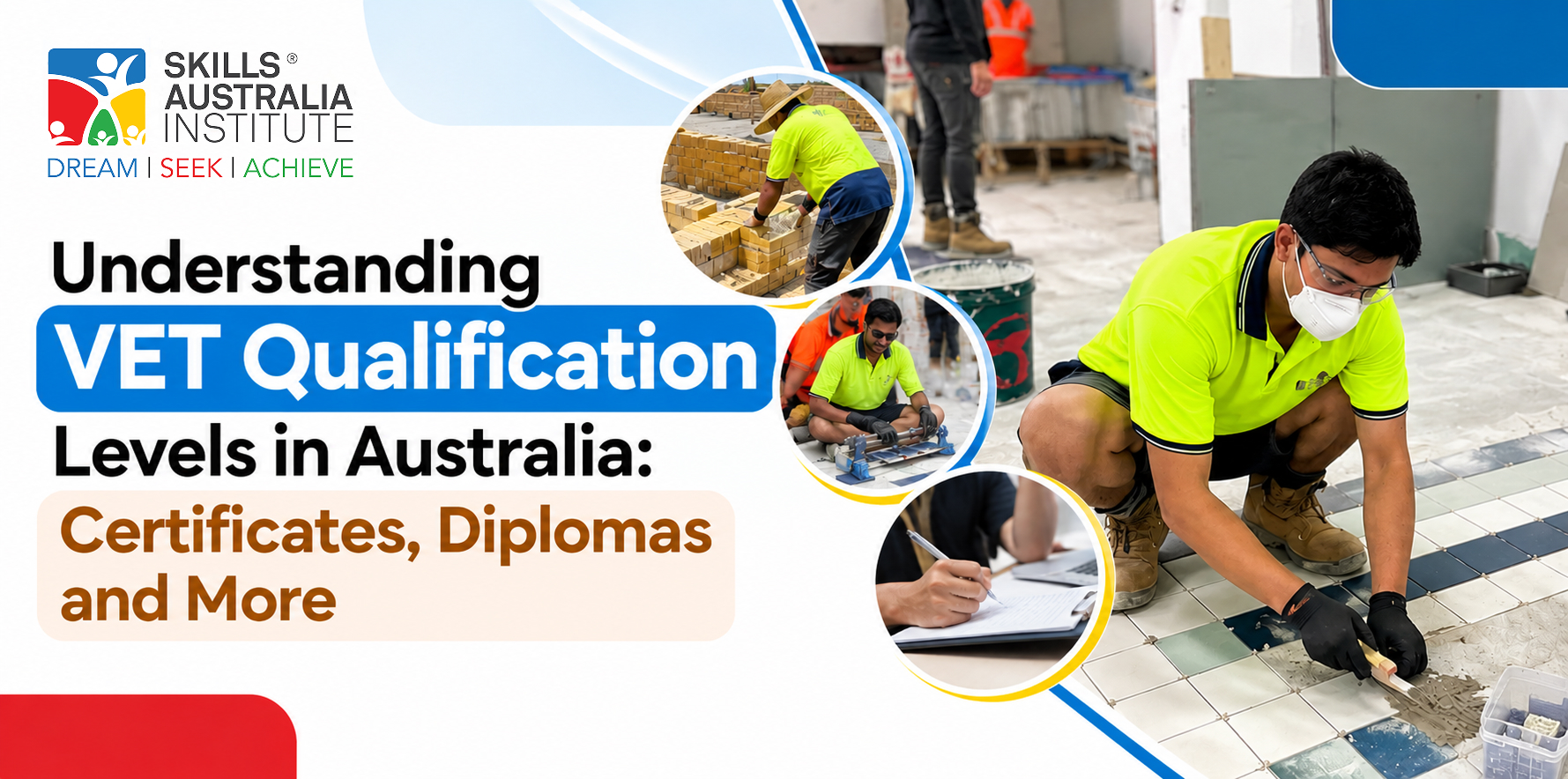
Choosing an education institute in Australia for VET (vocational education and training) is confusing, as every college website says something different. One says job-ready, another says supervisor role, and another says a different pathway. From business and management to trades like carpentry, floor and wall tiling, bricklaying and blocklaying, there are options for almost every career you can think of. You just have to understand levels. Once you get what each level means, picking becomes way easier.
Let’s understand everything about VET qualifications levels in Australia, including the difference between Cert III and Diploma, why there are so many levels, and more.
VET (vocational education and training) is practical-based learning where you do workshop tasks, live activities, and workplace tasks, as well as assessments that are competency-based.
For example, in a business-focused VET program, you might learn workplace communication, admin, customer service, and how business ops work. Likewise, carpentry courses have a totally different syllabus with a very different experience. Imagine it like you are in a workshop, reading plans, picking materials, using tools safely, and building things.
That’s why VET suits so many people, including school leavers, career changers, and even people already working who want to add new skills to their portfolios. You can choose the ideal VET programs by shortlisting the best colleges in Australia, checking RTOs (registered training organisations), and other approved VET providers.
AQF has ten levels. Level 1 is Certificate I and Level 10 is a doctoral degree. It covers learning from very basic to advanced levels.
Let’s take a quick look at a breakdown for each.
However, this is just a standard guide, and actual content and entry requirements may vary depending on the specific qualification and training package. So always check the details before going through a specific vocational education and training program.
Most people start with these certificates, whereas each level has a different purpose.
Certificate I and II are foundational courses; if you’re totally new to a field and want to build confidence first, you can learn the basics.
Certificate III is where it gets serious for skilled work. Certificate III is usually the trade-level training that includes structured training with workplace experience or an apprenticeship. So if you’re into Carpentry, Floor and Wall Tiling, or Bricklaying and Blocklaying, you should usually start with Certificate III pathways.
Each trade has its own practical skills; Carpentry involves measuring, cutting and framing wood. Floor and Wall Tiling focuses on preparing surfaces and fitting tiles accurately. Bricklaying certificate involve laying bricks, mixing mortar and following building plans.
Certificate IV is the next step where you can get more specialised knowledge with greater responsibility. Cert IV suits people who already have some experience and want to move towards a supervisory role or get ready for further study.
Certificate III and Certificate IV serve different purposes; Certificate III focuses on practical skills and job-specific skills, while Certificate IV builds on more advanced knowledge, problem-solving, and working responsibilities. The exact difference depends on the course and industry.
In easy words, Certificate III focuses more on doing the job, while Certificate IV can prepare you for more specialised tasks and responsibilities.
No, not really. It is not always necessary to complete a Certificate III before you move to a Certificate IV or a diploma. Your entry requirements depend on the course and training provider.
Some courses may require previous qualifications or relevant work experience, so it is important to check the requirements before enrolling.
After certificates, everyone asks – Should I do a diploma or an advanced diploma? Which is better?
Well! The fact is, neither is automatically better, as it depends on your goal.
A diploma is AQF Level V and gives you broader technical and theoretical knowledge. It is good if you want advanced, skilled work or business responsibilities, or if you want to use it as a pathway to further study later. Say, in a business diploma, you might do operational planning, project coordination, workplace leadership, and business processes.
Advanced Diploma is Level VI, which is more specialised, with more complex tasks, more decision-making, and more autonomy. Suits someone aiming for advanced technical or management responsibilities. However, you must not pick a higher-level course just because it sounds better; instead, check course content, entry requirements, progression options, and more to make informed decisions.
Finding the right course and the best colleges in Australia is essential to get practical learning. Choosing a college for VET is what matters more is – do they have proper practical facilities? Do they have industry connections? How experienced are trainers? Do they provide workplace learning? If you want carpentry, you need a proper workshop and hands-on teaching.
If you want floor and wall tiling, you need training that actually teaches measuring, surface prep, and installation properly. Business students benefit from realistic projects – communication, planning, everyday business stuff.
Before you enrol, ask these seriously:
If you’re international, is the provider and course CRICOS approved for a student visa?
Very important. You can check recognised VET qualifications and RTOs on training. gov. au. International students should also check CRICOS registration.
Yes, you can, as VET can give you pathways to further study, though it’s not always automatic. Some students start with a certificate, get experience, and then go for higher qualifications later. Others use a diploma as a stepping stone to further education, depending on credit transfer and admission policy of the next institution.
This flexibility helps if you’re still figuring out where your career will go. You don’t need to plan everything from day one, but understanding possible pathways helps you avoid picking a course that doesn’t support your long-term goals.
Your career goals help you choose the right VET qualification. Construction focuses on trade skills, automotive on vehicle repair, hospitality on cooking and management, and business on administration and operations. Choose a course that matches your career plans.
Different colleges and training providers may offer courses at the same qualification, but their level may be different from content, duration, fees, practical training and requirements. Comparing all the details beforehand, along with all the facilities and student support, helps you choose the right provider for your needs.
Avoid these common mistakes when choosing a VET course:
International students should check whether a course is available to them and whether the provider is registered to enrol international students. It is also important to review English language requirements, tuition fees, course duration and intake dates before applying. Always confirm the latest details with the provider and official Australian government sources.
Once you understand VET levels, comparing courses becomes much easier. Certificates help you build foundational or trade-specific skills, while diplomas and advanced diplomas give you broader knowledge and a chance to take on more complex responsibilities.
Whether you’re into business, carpentry, floor and wall tiling, or bricklaying and blocklaying, start with the work you want to do and find a qualification that supports that direction.
Take time to compare providers, verify registration, and review course requirements properly. The right institute isn’t the one with the flashiest marketing. It’s the one offering recognised training that fits your needs and prepares you for the next step. And if you’re still confused – just talk to experts at Skills Australia Institute, who provide practical training and can help you choose the right course to continue your learning and skill enhancement.


I enjoy attending the school, the learning experience is really good. I get to interact with the trainers and people from diverse backgrounds and cultures. I love the school.

I think the school is very nice. Teacher is very supportive and good. And also improve my English in the all English environment. I love this school!

Staffs and trainers are good and I am enjoying my course with my classmates and friends.

The trainers here are very nice and polite towards students. The way they train us are very nice and easy to understand. The environment of the college is also nice, everyone is respectful.

Going far and beyond just educating students. Its how the educators broaden my way of thinking. In a new country I used to be limited underachieving and to shy to voice my opinions , but they bridged the gap. That's how SAI has really grown my passion in Early Childhood Development. Forever grateful.

Being an international student is exciting but if I would describe my experience in one word It is life changing studying abroad is quite challenging, it is an experience of a lifetime for me. It is about learning new things, culture and enhanced my skills in cooking. The teachers and staff were very helpful, professional and hands on when it comes to teaching us new skills and knowledge. I can say that studying at SAI allowed me to gain new perspective which would benefit me in the future.

I enrolled Carpentry course at SAI last year July, since that time I feel so grateful to study here. They have really good trainers that you can be a good friends as well. The tools that they have brilliant, they have everything. It helps us along. Never regret to choose SAI to study.

In the spirit of reconciliation, Skills Australia Institute acknowledges the Traditional Custodians of the country throughout Australia and their connections to land, sea and community. We pay our respect to their Elders, past and present and extend that respect to all Aboriginal and Torres Strait Islander peoples today.

At Skills Australia Institute, we strive to create a secure and inclusive space for the LGBTQIA+ communities.