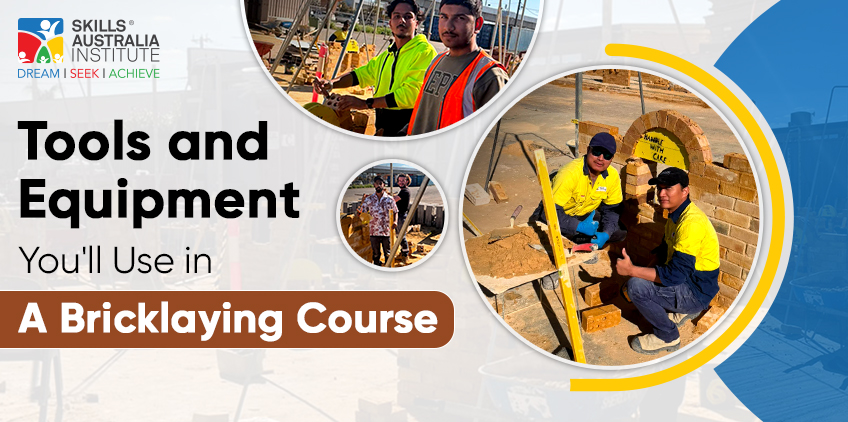
A successful bricklayer is expected to possess not just the practical skills but also an in-depth knowledge of how to operate the necessary tools. Students undertaking the CPC33020 Certificate III in Bricklaying and Blocklaying get to know how various types of hand tools, power tools, and construction materials are utilised in real building sites.
The compulsory vocational training of the course allows pupils to get familiar with the industry-standard tools. The hands-on experience gained from using such tools is essential in boosting their confidence level before going into actual construction work.
A bricklaying course teaches you many different tools utilised in the construction of homes and buildings. All these tools have particular purposes in either laying the bricks or measuring and mixing the mortar.
Students pursuing a CPC33020 Certificate III in Bricklaying and Blocklaying for international students are also taught how to handle these tools effectively and safely. Knowing the proper tools is as important as knowing the construction techniques.
Hand tools are used on almost every bricklaying project. They help trainees develop accuracy, consistency, and good workmanship throughout their training.
The brick trowel is one of the important tools that plays a critical role in all the practicals covered in the course. It is designed for spreading mortar, positioning bricks and removing excess mortar in construction. As a result of consistent training, students learn to handle this tool professionally to ensure clean finishing.
Jointing and pointing tools assist in shaping mortar joints once bricks are laid in place. Proper finishing makes brickwork more attractive and durable. Students prioritise this vocational training as they are widely used across Australian construction projects.
To construct straight walls, it is important to use accurate measurements. Spirit levels and line pins assist in checking whether the brickwork is levelled, aligned and plumb. Proper use of this equipment will reduce errors during Bricklaying.
Not all bricks can fit in position. With the help of this tool, trainees will be able to cut bricks to the necessary sizes. This tool is frequently used when working with windows, doors and corner positions.
Gauge rods and corner blocks are essential in ensuring uniform brick courses throughout the whole process. These tools are highly reliable and ensure faster and more accurate work. Students realise quickly how much effort can be saved by measuring precisely.
| Tool | Purpose | How It Is Used in Training |
|---|---|---|
| Brick Trowel | Spreading and shaping mortar | Used to pick up, spread, and place mortar while laying bricks accurately. |
| Jointing and Pointing Tools | Finishing mortar joints | Used to smooth and shape joints after bricks are laid for a clean finish. |
| Spirit Level and Line Pins | Checking alignment and level | Used to ensure walls are straight, level, and properly aligned during construction. |
| Bolster Chisel and Club Hammer | Cutting bricks | Used together to split or cut bricks to required sizes for corners and edges. |
| Gauge Rod and Corner Blocks | Maintaining measurements and alignment | Used to keep consistent height and structure across brick courses during building work. |
The use of power tools is another modern approach used to facilitate construction tasks more effectively. Students going to study in Perth are trained on their usage under supervision during the Bricklaying and blocklaying course.
A brick saw ensures accurate cutting of bricks and concrete blocks, while an angle grinder helps in trimming and smoothing rough edges of materials. Pupils are trained on how to use these machines safely.
Mortar preparation can prove to be a tedious process. Drills used for mixing mortars ensure an even mixture and help bricks bond better, reducing wastage. Understanding the right consistency of mortar becomes one of the important aspects of practical training.
Laser levels are used as accurate references for large construction projects. The use of such tools and how they ensure accuracy is taught to students undertaking the Bricklaying course Perth. Such tools have become more common in modern-day construction projects.
| Tool | Purpose | How It Is Used in Training |
|---|---|---|
| Brick Saw and Angle Grinder | Cutting and shaping bricks | Used to cut bricks and blocks accurately and trim edges for fitting in walls and corners. |
| Mixing Drill and Mortar Mixer | Preparing mortar mix | Used to mix mortar evenly for strong bonding between bricks and blocks. |
| Laser Level | Checking alignment and accuracy | Used to ensure walls are straight, level, and properly aligned during construction work. |
Another aspect of learning includes getting acquainted with construction materials. It allows learners to get familiarised with different kinds of materials that are used in construction processes.
Different types of clay bricks, concrete blocks, and other masonry materials are used by students for training purposes. The difference between these materials is necessary to know for selecting a proper one.
This construction material is used for fastening bricks and blocks and ensuring the durability of brickwork. During practical sessions, students become familiarised with the correct mixing and application ratio.
For some constructions, there may be a need for special products that would increase durability and resistance to moisture. Pupils learn when and how to apply adhesives, grout, and damp-proof courses while following industry standards.
Safety is always paramount at construction sites. Students are taught to ensure their safety during the handling of tools and machinery, as well as when working with heavy materials.
This involves hard hats, safety boots, gloves, high-visibility clothing, safety glasses and hearing protection. Pupils learn the times and occasions that require the wearing of PPE and why proper PPE reduces workplace injuries.
Work health and safety requirements are incorporated in all practical sessions. Students will learn how to recognise hazards and apply safe work practices and equipment usage.
All these are important for someone who is undertaking a Certificate III in Bricklaying program.
| Category | Details | How It Is Used in Training |
|---|---|---|
| Personal Protective Equipment (PPE) | Hard hats, safety boots, gloves, high-visibility clothing, safety glasses, hearing protection | Worn during all practical activities to protect students from injury while using tools and materials. |
| WHS Requirements for Bricklaying Students | Hazard identification, safe work methods, manual handling rules, emergency procedures, site safety rules | Followed during training to ensure safe behaviour and compliance with construction site standards. |
It is not always necessary for students to purchase their own tools, depending on where they will receive their training. Some of these tools are supplied during the training period.
It is crucial to determine this before commencing a Bricklaying course in Australia. The use of basic hand tools is always necessary for practice. There are students who choose to purchase their own tools, as it helps them become familiar with equipment used on real sites.
It is essential that tool training prepares you for real construction work. The training teaches students about the right use of the equipment. They gain practical skills through training, making them more confident and precise in their work. Students learn how to:
The training offered in the best colleges in Perth also improves problem-solving skills, as they are crucial in any construction work. Ultimately, working together in practical activities enhances teamwork among individuals.
Enrolling in the CPC33020 Certificate III in Bricklaying and Blocklaying allows learners to equip themselves with relevant practical skills that are highly beneficial within the construction industry. The course offers practical training and exposure to a real construction site.
Skills Australia Institute, one of the best colleges in Australia, gives industry-based training to future tradesmen. Most students opt for a bricklaying course in Australia as the starting point of their career.
Answer: The brick trowel is the most important tool. It is used for spreading mortar and placing bricks accurately.
Answer: Yes. Students are trained to use power tools like brick saws, angle grinders, mixing drills, and laser levels under supervision.
Answer: Most RTOs provide basic tools and training equipment during practical classes. Students may need to bring some personal hand tools depending on the provider.
Answer: Students need PPE such as safety boots, gloves, high-visibility clothing, safety glasses, and hard hats. This equipment is required on all training and construction sites.



I enjoy attending the school, the learning experience is really good. I get to interact with the trainers and people from diverse backgrounds and cultures. I love the school.

I think the school is very nice. Teacher is very supportive and good. And also improve my English in the all English environment. I love this school!

Staffs and trainers are good and I am enjoying my course with my classmates and friends.

The trainers here are very nice and polite towards students. The way they train us are very nice and easy to understand. The environment of the college is also nice, everyone is respectful.

Going far and beyond just educating students. Its how the educators broaden my way of thinking. In a new country I used to be limited underachieving and to shy to voice my opinions , but they bridged the gap. That's how SAI has really grown my passion in Early Childhood Development. Forever grateful.

Being an international student is exciting but if I would describe my experience in one word It is life changing studying abroad is quite challenging, it is an experience of a lifetime for me. It is about learning new things, culture and enhanced my skills in cooking. The teachers and staff were very helpful, professional and hands on when it comes to teaching us new skills and knowledge. I can say that studying at SAI allowed me to gain new perspective which would benefit me in the future.

I enrolled Carpentry course at SAI last year July, since that time I feel so grateful to study here. They have really good trainers that you can be a good friends as well. The tools that they have brilliant, they have everything. It helps us along. Never regret to choose SAI to study.

In the spirit of reconciliation, Skills Australia Institute acknowledges the Traditional Custodians of the country throughout Australia and their connections to land, sea and community. We pay our respect to their Elders, past and present and extend that respect to all Aboriginal and Torres Strait Islander peoples today.

At Skills Australia Institute, we strive to create a secure and inclusive space for the LGBTQIA+ communities.