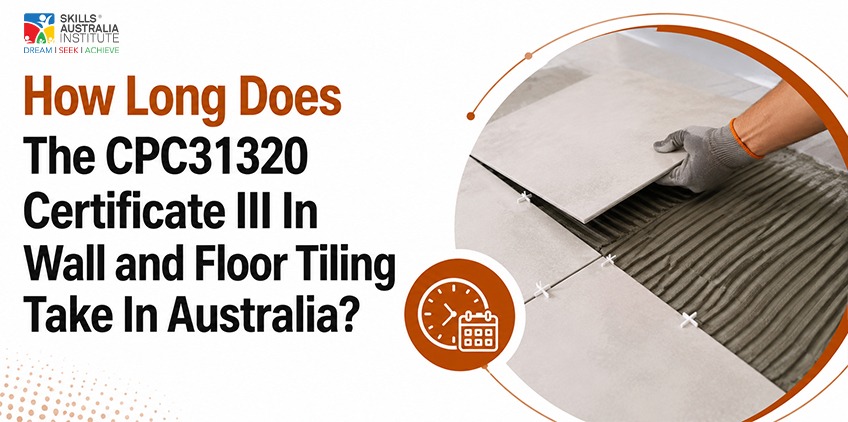
Opting for a career in trade can ensure that one gets stable employment as well as learn valuable skills. Among the many construction trades in Australia, wall and floor tiling is still popular among students who like hands-on work and creative detailing.
However, students choosing to pursue a trade career often want to know how long it takes and what to expect from the training. This blog explains everything about CPC31320 Certificate III in Wall and Floor Tiling in a simple and easy way.
Construction Trade CPC31320 Certificate III in Wall and Floor Tiling is a nationally recognised training program aimed at students who wish to pursue a career as professional tilers in Australia. The course emphasises the theoretical knowledge and practical skills essential for tiling work in residential, commercial and industrial projects.
Many training providers offering college courses include workshop-based learning so students can gain real industry exposure before entering the workforce.
Generally, the duration of CPC31320 Certificate III in Wall and Floor Tiling in Australia depends on the training provider, study mode and the practical placement requirements. But most institutes have a planned course that is completed within 104 weeks.
The standard course duration includes:
For many students planning to study in Perth, the structured semester system also provides flexibility to balance studies, part-time work and practical training opportunities.
Several factors can influence how quickly students complete the qualification. Some of them are as follows:
Students enrolled in full-time programs are likely to finish the course on time. Full-time learning requires regular classroom sessions, workshops and practical assessments all year round.
Students who attend part-time may require more time because classes are spread across fewer study hours each week. This option is best for working professionals or students managing additional responsibilities.
Trade courses are a hands-on learning experience. Students will need to have hands-on skills in cutting, measuring, laying and repairing tiles before they can be certified.
Students may need to do some workshop activities and live project assessments for training providers. One of the most beneficial components of the CPC31320 Certificate III in Wall and Floor Tiling is the practical sessions, which will make students feel ready for actual construction environments.
Some students participate in apprenticeships and work training while undertaking their studies. Apprenticeships offer direct experience of industry and the opportunity to learn from expert professionals.
Work placement could impact the total time spent on education because of the schedule of employers and the availability of places for work placement. But apprenticeships are known to boost employability after education.
The course is a combination of both technical knowledge and practical skills. This will train the students to work as job-ready tiling professionals. During the training, candidates acquire some valuable skills in tiling and construction work.
The course teaches how to read plans, estimate materials, organise equipment and manage tiling tasks efficiently.
It is crucial to make accurate measurements when tiling. Students are taught mathematical calculations for spacing, alignment and quantities of materials.
Students learn about various wall and floor tiling materials, adhesives and finishing products that are utilised in contemporary construction.
The surfaces need to be properly cleaned, levelled and prepared prior to apply the tile. Students are taught methods of tile preparation that enhance tile strength and finish.
Students will learn to plan a tile layout, apply adhesive and install floor tiles in residential and commercial applications.
Students practice wall tiling techniques for kitchens, bathrooms and decorative feature areas.
Repair skills help students replace damaged tiles, fix uneven surfaces and restore tiled spaces professionally.
The course opens up a number of career pathways within the construction sector.
1) Tiler: The majority of graduates start as tilers for renovation, shopping centres, residential homes and offices.
2) Tiling Supervisor: Experienced tilers can move on to supervisory positions where they manage workers, coordinate projects and oversee installation quality.
3) Specialist Tiler: Specialist tilers focus on decorative, luxury or custom tiling projects requiring advanced craftsmanship and creative designs.
4) Trainer/Assessor: Vocational education institutions may eventually hire skilled professionals who have industry experience to teach future tilers.
Australia offers excellent opportunities for students interested in skilled trades and construction careers. As the country prioritises infrastructure and property development, there is a strong economic value to trade professions.
Qualified tilers remain in demand because construction and renovation projects continue throughout Australia. There are good job prospects in skilled trades.
The demand for tilers is high, particularly in the commercial sector for larger projects or operating independent businesses.
Tilers work across homes, offices, hotels, retail spaces and industrial sites. This variety keeps the profession interesting and dynamic.
Students choosing vocational courses for international students often prefer practical trades because they combine skill development with strong employment pathways.
Students acquire useful technical and professional skills during workshops and site-based learning.
This qualification is perfect for students who prefer to pursue careers in trades-related fields over traditional office work.
Admission criteria may slightly vary according to the different training providers, but most of them have similar requirements for training.
a) Have 10th and Equivalent Education:-
The usual requirement for applicants is to complete Year 10 (or equivalent) prior to applying.
b) Pre-apprenticeship or Relevant Work Experience:-
Some institutes may prefer students to have some construction knowledge or prior work experience, but this is not strictly required.
c) Valid Documentation:-
Students are required to bring identification, academic records and visa documents if applying as international students. They must also bring prior training certificates or licenses and health and character certificates.
d) English Requirements:-
International applicants may need to demonstrate English language proficiency through recognised tests or previous academic studies.
A career in CPC31320 Certificate III in Wall and Floor Tiling offers practical learning, stable employment opportunities and long-term growth within Australia’s construction industry. The qualification provides a balanced combination of technical knowledge and hands-on training that prepares students for real job environments.
One of the best colleges in Australia, like Skills Australia Institute, helps students gain professional trade training through structured learning programs and practical industry exposure.
Answer:- To become a professional tiler in Australia, students usually complete CPC31320 Certificate III in Wall and Floor Tiling through a registered training provider.
Answer:- Course fees vary depending on the institution, student status and training structure. The estimated tuition fees and resource fees for the CPC31320 Certificate III in Wall and Floor Tiling are $24,000 and $2,000.
Answer:- Usually, the salary of a tiler and a wall tiler is up to $75,000 to $85,000 per year. Earnings often increase for those working on commercial or custom projects.
Answer:- The most common qualification is CPC31320 Certificate III in Wall and Floor Tiling. Employers may also value practical experience, apprenticeships and workplace safety knowledge.


In the spirit of reconciliation, Skills Australia Institute acknowledges the Traditional Custodians of the country throughout Australia and their connections to land, sea and community. We pay our respect to their Elders, past and present and extend that respect to all Aboriginal and Torres Strait Islander peoples today.

At Skills Australia Institute, we strive to create a secure and inclusive space for the LGBTQIA+ communities.