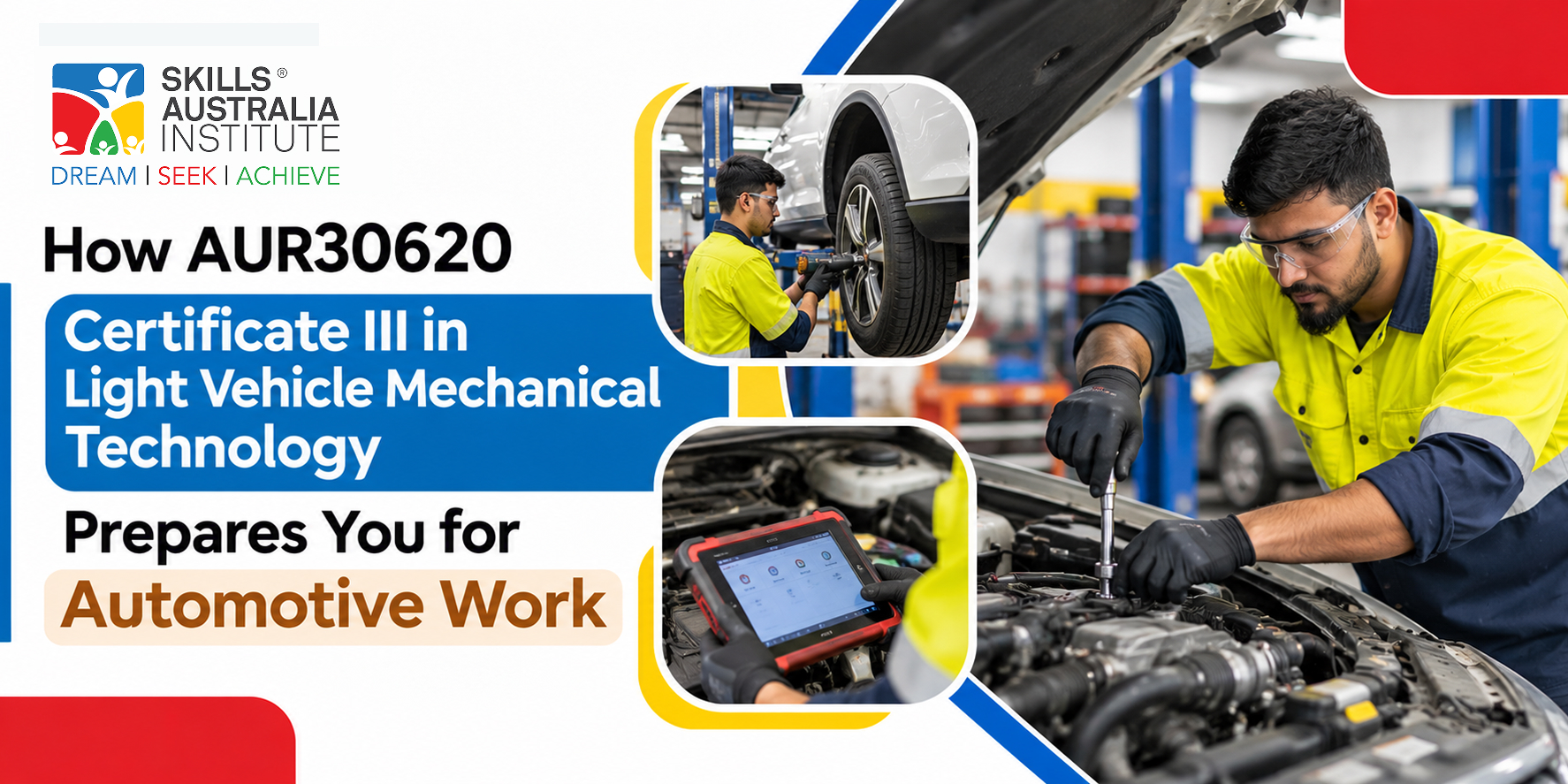
If you like working with your hands and working out why a car won’t start, a trade qualification can turn that into a career. Automotive courses are popular among vocational courses in Australia, and for every vehicle used, there will be a time to service it and repair it.
AUR30620 Certificate III in Light Vehicle Mechanical Technology is the basic automobile mechanics certification for individuals who are interested in performing their mechanical activities on light vehicles and cars. In this guide we will talk about the content of the course that you will be learning from, the skills that you will acquire in this course and use in your profession, the career opportunities you will have with this course and finally the person suited for this course.
The AUR30620 Certificate III in Light Vehicle Mechanical Technology is a nationally recognised qualification that can be used by all people working in the automotive retail, service and repair industry to perform a range of activities on light vehicles. There are quite a few students out there looking for it as the cert 3 light vehicle mechanic course.
The course is delivered face to face at Skills Australia Institute, an education institute in Cannington, Perth for 78 weeks. That’s three semesters of 26 weeks, made up of six 10-week terms with a three-week break after each one.
There are over 30 units in the auto mechanic certificate course. The following are the primary areas of skill.
You acquire the skills to perform vehicle service, test and change batteries, jump-start vehicles and check and service engines. These are regular jobs that occur in the workshop.
The units include engines, cooling systems, exhaust and emission control and petrol and diesel fuel systems. You also fix manual and automatic transmissions, clutches and drive shafts.
These systems affect safety, so the course covers them closely. You diagnose and repair hydraulic brakes, steering and suspension, and handle tyres, wheel assemblies and wheel balancing.
Modern vehicles rely on electronics, so you learn to develop diagnostic test strategies. Units include charging, starting, ignition, engine management and warning systems.
Safe work procedures are first. Environmental best practices, tool and measuring equipment maintenance, and effective communication within the workshop are some things you will be learning.
The assessment includes both classwork and work placement that involves practical demonstration and projects. Vocational placement takes place in terms 5 and 6, with 24 hours per week over a period of 20 weeks, totaling 480 hours of work within a workplace.
This is the area where you are taught to use the equipment effectively and select the right tool.
Diagnosis involves a series of steps. You are taught how to test, identify the problem and fix it rather than making assumptions and exchanging parts.
The assessment of cert 3 light vehicle mechanic is practical-based where you will learn to demonstrate your proficiency in each of the tasks according to automotive industry standards.
The course description mentions Motor Mechanic (General) and Automotive Light Vehicle Mechanical Repair Technician as careers post-qualification. The course skills are applicable in related jobs too, with job titles depending on the individual companies.
Maintenance, repair and diagnostics of cars or similar light vehicles; engine, brake and drivetrain repair.
Routine maintenance and checking of the vehicles, such as oil levels, tyres and batteries to ensure that these vehicles are safe between repair jobs.
Maintains the maintenance and faults checking for example within a company that uses its own vehicles.
For further study, the course allows progression to AUR40226 Certificate IV in Automotive Mechanical Diagnosis.
This course suits:
For international students, the requirements are:
Australian permanent residents should check the domestic students section of the website.
Vocational courses are specially designed to make you ready for a particular role with a recognised qualification in a proper way to showcase your practical skills. When comparing between the top schools in Australia for a AUR30620 Certificate III in Light Vehicle Mechanical Technology, consider hands-on training, an internship, international student support and certification. Skills Australia Institute is a Registered Training Organisation (RTO 52010) with CRICOS code 03548F. The SAI Perth intakes for 2027 are 4 January, 5 April, 5 July and 4 October. This course is not currently accepting new students for Adelaide.
Answer:- In this course, you get training in routine maintenance, vehicle servicing, steering and suspension work, engine and mechanical repair, and braking system diagnostic. The course also includes diagnostics and fault finding as well as safe work practices, tool use and good communication within an automotive workplace.
Answer:- The course is a 78 week program. This is three semesters of 26 weeks, consisting of six 10-week semesters of study separated by a 3-week break between semesters. Courses are taught in person at the SAI Cannington campus.
Answer:- Yes. Assessment is a mixture of classroom tasks and work placement, and incorporates some practical demonstrations. Vocational placement will take place during terms 5 and 6, 24 hours a week for 20 weeks (480 hours).
Answer:- The course page lists Motor Mechanic (General) and Automotive Light Vehicle Mechanical Repair Technician as job roles. Related service and maintenance roles may also suit your skills, and you can keep studying with the Certificate IV in Automotive Mechanical Diagnosis.
Answer:- Yes. International students must be at least 18, meet the education requirement and show English proficiency through an accepted test or the institute’s English Placement Test. Student visa applicants must also meet Home Affairs requirements. The course is currently delivered in Perth.


I enjoy attending the school, the learning experience is really good. I get to interact with the trainers and people from diverse backgrounds and cultures. I love the school.

I think the school is very nice. Teacher is very supportive and good. And also improve my English in the all English environment. I love this school!

Staffs and trainers are good and I am enjoying my course with my classmates and friends.

The trainers here are very nice and polite towards students. The way they train us are very nice and easy to understand. The environment of the college is also nice, everyone is respectful.

Going far and beyond just educating students. Its how the educators broaden my way of thinking. In a new country I used to be limited underachieving and to shy to voice my opinions , but they bridged the gap. That's how SAI has really grown my passion in Early Childhood Development. Forever grateful.

Being an international student is exciting but if I would describe my experience in one word It is life changing studying abroad is quite challenging, it is an experience of a lifetime for me. It is about learning new things, culture and enhanced my skills in cooking. The teachers and staff were very helpful, professional and hands on when it comes to teaching us new skills and knowledge. I can say that studying at SAI allowed me to gain new perspective which would benefit me in the future.

I enrolled Carpentry course at SAI last year July, since that time I feel so grateful to study here. They have really good trainers that you can be a good friends as well. The tools that they have brilliant, they have everything. It helps us along. Never regret to choose SAI to study.

In the spirit of reconciliation, Skills Australia Institute acknowledges the Traditional Custodians of the country throughout Australia and their connections to land, sea and community. We pay our respect to their Elders, past and present and extend that respect to all Aboriginal and Torres Strait Islander peoples today.

At Skills Australia Institute, we strive to create a secure and inclusive space for the LGBTQIA+ communities.