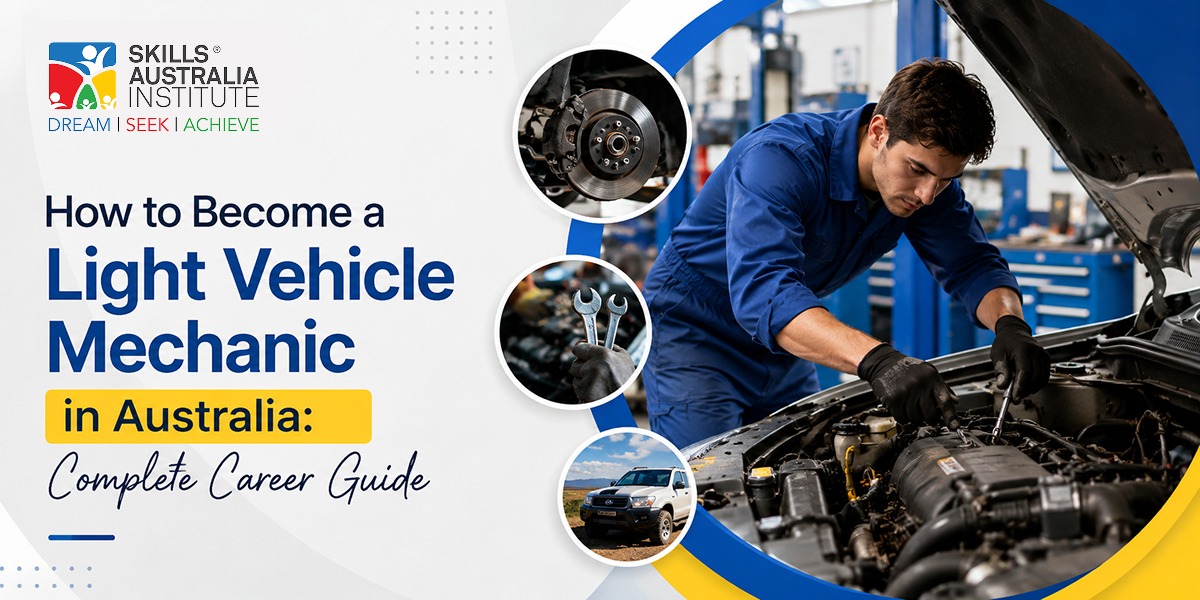
Australia’s automotive industry relies on skilled professionals to keep vehicles safe, efficient and roadworthy. With the development of technology in vehicles, there is an increased demand for skilled mechanics who can operate and repair both conventional mechanical components and new vehicle technologies. For individuals who enjoy practical work and problem-solving, becoming a light vehicle mechanic can offer a rewarding and stable career path. Through recognised vocational education and training, students gain the technical knowledge and hands-on experience needed to enter the industry.
This blog explains the qualifications, training pathway, career opportunities and earning potential for aspiring light vehicle mechanics in Australia.
Light vehicle mechanics check and service passenger cars to ensure they run in a safe manner. They work with several components of vehicles such as engines, transmissions, electrical system components and brakes.
A formal training program is the most popular way to enter the automotive industry. AUR30620 Certificate III in Light Vehicle Mechanical Technology prepares students for entry-level automotive roles. Some individuals interested in becoming mechanics may begin their careers by enrolling in formal automotive courses that provide both theoretical and practical learning opportunities.
To enrol in training programs, one must be at least 18 years old and must have finished Year 10 or an equivalent course.
International students must also prove their English language proficiency through one of the following:
The AUR30620 Certificate 3 in Light Vehicle Mechanical Technology qualification combines classroom learning with practical workshop training to prepare students for real-world automotive environments.
The students gain the skills of performing routine service operations, examining vehicle parts and discovering maintenance needs. These skills represent the basis of automotive repair work.
The training includes important systems such as the engine, brakes, steering and suspension systems. Practical skills are taught regarding inspection, maintenance and repair of these systems.
Modern vehicles rely heavily on electronic systems. The course teaches students about testing electrical circuits and troubleshooting faults in these systems.
Safety will continue to be a major part of the training. The students gain the ability to identify hazards, manage risks and work safely in a professional workplace.
To be in the automotive industry, one needs education, training and workplace experience.
The first step is enrolling in a recognised motor mechanic course that provides industry-relevant knowledge and practical skills.
Practical learning is essential in automotive training. Students spend significant time working with tools, equipment and vehicle systems in workshop settings.
There are some training programs that involve workplace training whereby the students gain experience through the supervision of experts in the industry.
Through the program, the trainee gets technical knowledge, diagnostic capabilities and work skills that would be essential for all employers.
Trainees can start applying for jobs in the automotive industry once they complete their training programs.
Qualified mechanics can work in a variety of automotive environments. The skills acquired from training can be easily applied across different work settings.
Independent workshops offer the chance to work on servicing and repairing various types of vehicles.
Many mechanics find employment with dealerships where they service vehicles according to manufacturer standards and specifications.
Businesses operating vehicle fleets often employ mechanics to maintain company vehicles and minimise operational downtime.
Mechanics can work with businesses that specialise in vehicle diagnostics, performance improvements, brakes, suspensions or automotive electricity.
After being trained in the automotive field, there are a number of careers you can pursue.
This is the most common job position for those who have graduated from an automotive program.
Automotive technicians specialise in the repair and diagnosis of automobiles through the use of advanced machinery.
Service technicians carry out regular maintenance and ensure that the vehicle meets all safety requirements.
The diagnostic technician focuses on troubleshooting complex mechanical and electrical problems.
Qualified light vehicle mechanics in Australia commonly earn between $80,000 and $90,000 per year. Higher earnings can also be attained by mechanics who possess more knowledge about diagnosis and have special skills or experience in the industry.
Additional certifications and professional development can improve one’s earning capacity as well.
Students who have successfully completed the AUR30620 Certificate III in Light Vehicle Mechanical Technology can build a strong base for themselves to proceed to AUR40216 Certificate IV in Automotive Mechanical Diagnosis or any other related courses.
A career as a light vehicle mechanic offers practical work, strong employment opportunities and continuous learning.
Australia continues to experience demand for skilled automotive professionals as vehicle ownership remains high and automotive technology evolves.
This career is appropriate for those who like to use tools, resolve technical issues and see the direct results of their work.
The rise of hybrid and electric vehicles is creating new opportunities for mechanics to specialise in emerging technologies.
Automotive professionals can continue developing their skills throughout their careers, creating opportunities for advancement and higher earning potential.
Students considering AUR30620 Certificate III in Light Vehicle Mechanical Technology in Perth can benefit from industry-focused training that supports long-term career growth within Australia’s automotive sector.
Get enrolled in an accredited course for the automotive industry from the Skills Australia Institute and develop all the necessary skills that will help you become a successful light vehicle mechanic. Contact the institute today to explore available intakes and take the first step towards a rewarding automotive profession.
Answer: AUR30620 Certificate III in Light Vehicle Mechanical Technology program runs for 78 weeks and is delivered across three semesters, with each semester spanning 26 weeks. The course structure includes six study terms of 10 weeks each, complemented by three scheduled breaks of 3 weeks each, resulting in a total of 18 weeks of term breaks throughout the program.
Answer: Yes, it is one of the most recognised certifications for future mechanics and offers them the skills and knowledge that employers seek.
Answer: Yes, some of the students opt for automotive education without any previous knowledge and have gained experience through education and workshops.
Answer: Higher-paying jobs are commonly found in specialised areas of automobiles, mining zones, fleet servicing departments and diagnostic professions.
Answer: Yes, skilled mechanics are needed in many areas of Australia because of workforce needs and new developments in automobiles.



I enjoy attending the school, the learning experience is really good. I get to interact with the trainers and people from diverse backgrounds and cultures. I love the school.

I think the school is very nice. Teacher is very supportive and good. And also improve my English in the all English environment. I love this school!

Staffs and trainers are good and I am enjoying my course with my classmates and friends.

The trainers here are very nice and polite towards students. The way they train us are very nice and easy to understand. The environment of the college is also nice, everyone is respectful.

Going far and beyond just educating students. Its how the educators broaden my way of thinking. In a new country I used to be limited underachieving and to shy to voice my opinions , but they bridged the gap. That's how SAI has really grown my passion in Early Childhood Development. Forever grateful.

Being an international student is exciting but if I would describe my experience in one word It is life changing studying abroad is quite challenging, it is an experience of a lifetime for me. It is about learning new things, culture and enhanced my skills in cooking. The teachers and staff were very helpful, professional and hands on when it comes to teaching us new skills and knowledge. I can say that studying at SAI allowed me to gain new perspective which would benefit me in the future.

I enrolled Carpentry course at SAI last year July, since that time I feel so grateful to study here. They have really good trainers that you can be a good friends as well. The tools that they have brilliant, they have everything. It helps us along. Never regret to choose SAI to study.

In the spirit of reconciliation, Skills Australia Institute acknowledges the Traditional Custodians of the country throughout Australia and their connections to land, sea and community. We pay our respect to their Elders, past and present and extend that respect to all Aboriginal and Torres Strait Islander peoples today.

At Skills Australia Institute, we strive to create a secure and inclusive space for the LGBTQIA+ communities.