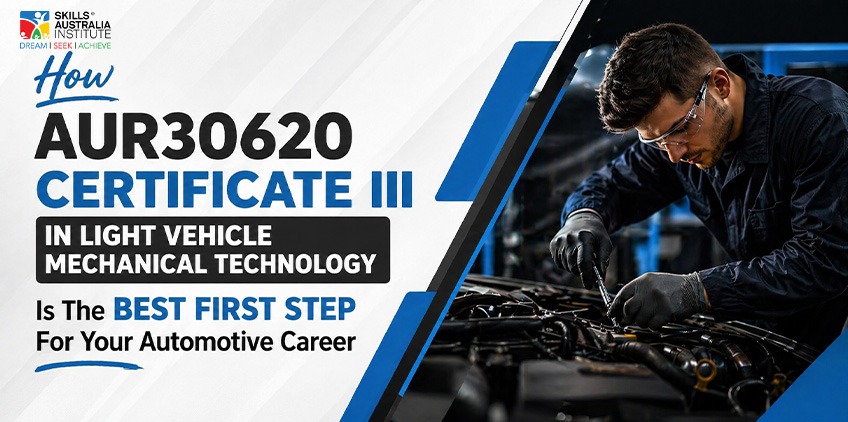
The AUR30620 Certificate III in Light Vehicle Mechanical Technology is among the most popular entry-level programs for candidates wishing to join the automotive industry in Australia. It offers practical training and necessary technical expertise in order to work with contemporary automobiles. As demand for skilled mechanics continues to grow, many students are turning towards structured vocational training to build strong careers.
This qualification helps students acquire practical experience while learning fundamental automotive systems. The goal is to get students ready for real workshop settings and help them grow their careers in the automotive industry over time.
This is a basic qualification meant for candidates who wish to become professional vehicle mechanics. It focuses on building both theoretical knowledge and practical skills in car repair, diagnostics, and servicing.
The course is popularly referred to as a stepping stone to the mechanical trade industry and is designed to meet the national skill standards.
Overall, this qualification makes sure that students are both confident and skilled before they start working.
The AUR30620 Certificate III in Light Vehicle Mechanical Technology is aimed at providing learners with a broad spectrum of technical and practical skills. It focuses on establishing the background to operate effectively in actual automotive conditions. Students will learn to comprehend the vehicle’s systems and be capable of doing necessary maintenance work.
The skills will make the graduates ready to work in entry-level positions and will enable them to adapt to different workshop environments with ease.
Completing the AUR30620 Certificate III in Light Vehicle Mechanical Technology Perth opens the door to several entry-level roles in the automotive industry. It provides a strong foundation for both employment and further study. Most of the learners begin with this qualification and slowly progress to specialised positions.
Earning potential in the automotive field depends on experience, location and skill level. The average salary for a car mechanic in Australia is between $80,000 to $90,000 per year.
The demand for skilled automotive professionals continues to rise across Australia due to increasing vehicle usage and technological advancements. Modern cars demand professional technicians who are aware of advanced systems and troubleshooting.
It is easy to sign up for this course, but you need to choose the right training provider carefully. Before applying, students should look at the course structures, facilities, and exposure to the industry.
The AUR30620 Certificate III in Light Vehicle Mechanical Technology program is an ideal starting point for anyone serious about building a future in the automotive industry. It is a blend of technical knowledge and practical skills that ensures that graduates are job-ready from day one. The well-organised methodology assists the learners to feel confident when they are operating in actual work conditions.
The best colleges in Australia, like Skills Australia Institute, support learners in gaining industry-relevant experience and guidance.
Q1. Why do you want to be an automotive technician?
Answer:- Becoming an automotive technician comes with the opportunity to improve your problem-solving skills. It is a skill that will help in your work life as well as your day-to-day activities.
Q2. What should an auto mechanic be capable of doing?
Answer:- An auto mechanic must be familiar with the latest vehicle technology. They should be able to detect minor issues early to prevent costly repairs. Another important skill required is the ability to handle various repair tools.
Q3. What are the three C’s of mechanics?
Answer:- The three Cs are Concern, Cause and Correction. Concern refers to the issue with the vehicle, as explained by the customer. Cause refers to the reason behind the issue that a mechanic determines after thorough inspections. Correction means offering the right solution to fix the issue.




I enjoy attending the school, the learning experience is really good. I get to interact with the trainers and people from diverse backgrounds and cultures. I love the school.

I think the school is very nice. Teacher is very supportive and good. And also improve my English in the all English environment. I love this school!

Staffs and trainers are good and I am enjoying my course with my classmates and friends.

The trainers here are very nice and polite towards students. The way they train us are very nice and easy to understand. The environment of the college is also nice, everyone is respectful.

Going far and beyond just educating students. Its how the educators broaden my way of thinking. In a new country I used to be limited underachieving and to shy to voice my opinions , but they bridged the gap. That's how SAI has really grown my passion in Early Childhood Development. Forever grateful.

Being an international student is exciting but if I would describe my experience in one word It is life changing studying abroad is quite challenging, it is an experience of a lifetime for me. It is about learning new things, culture and enhanced my skills in cooking. The teachers and staff were very helpful, professional and hands on when it comes to teaching us new skills and knowledge. I can say that studying at SAI allowed me to gain new perspective which would benefit me in the future.

I enrolled Carpentry course at SAI last year July, since that time I feel so grateful to study here. They have really good trainers that you can be a good friends as well. The tools that they have brilliant, they have everything. It helps us along. Never regret to choose SAI to study.

In the spirit of reconciliation, Skills Australia Institute acknowledges the Traditional Custodians of the country throughout Australia and their connections to land, sea and community. We pay our respect to their Elders, past and present and extend that respect to all Aboriginal and Torres Strait Islander peoples today.

At Skills Australia Institute, we strive to create a secure and inclusive space for the LGBTQIA+ communities.